
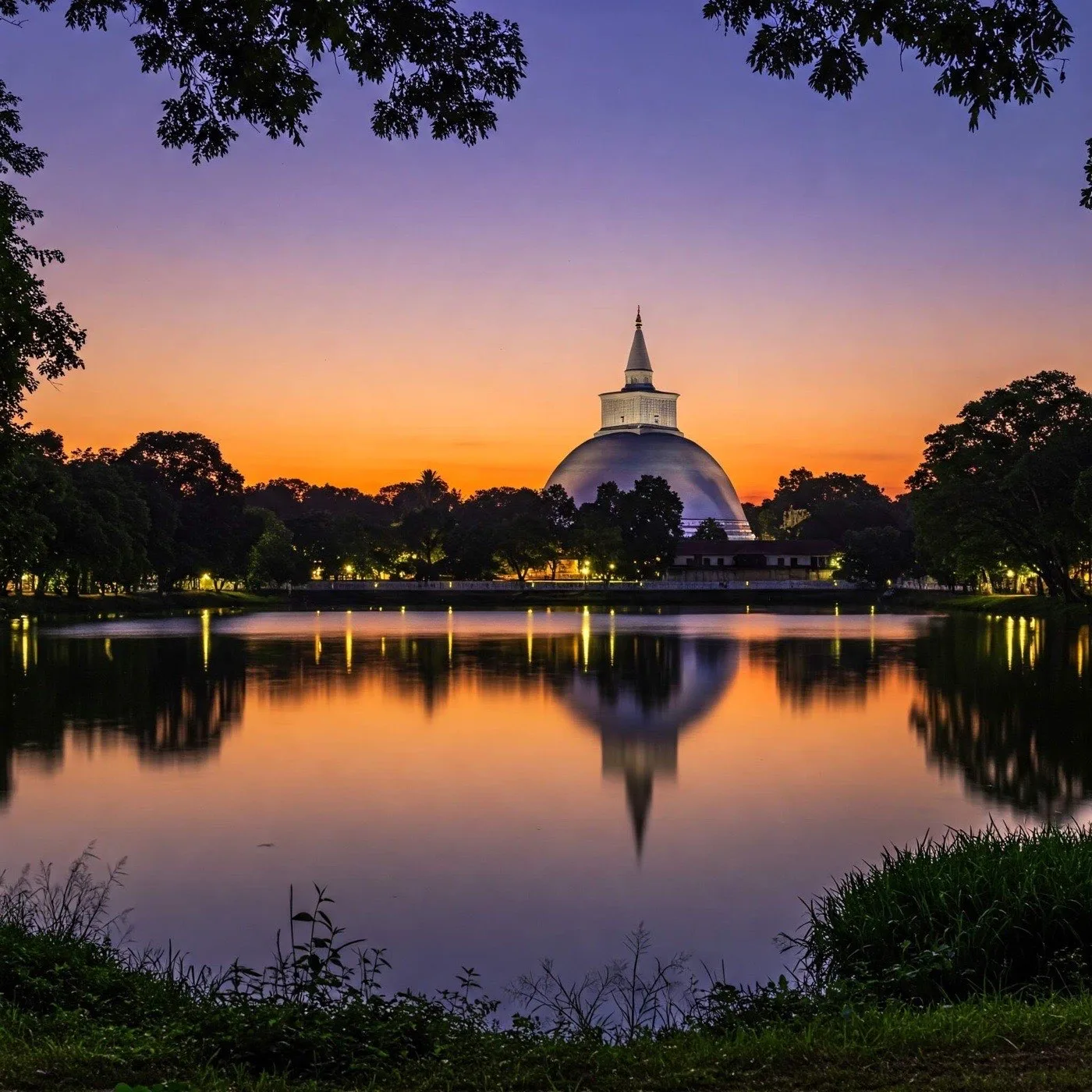
About Polonnaruwa
Polonnaruwa was Sri Lanka's second ancient capital, reaching its peak of power in the 11th–13th centuries AD under a succession of great kings including Parakramabahu the Great. Unlike Anuradhapura, Polonnaruwa is remarkably compact and well-preserved — a single archaeological park holds palaces, temples, stupas, and bathing pools in a well-organised, cycleable complex.
The highlight is the Gal Vihara — four enormous Buddha images cut directly into a single granite face: a 15m reclining Buddha, two seated Buddhas, and a 7m standing figure. The precision of the carving, accomplished without metal tools, remains one of the great achievements of ancient Sri Lankan craftsmanship.
The Parakrama Samudra (Sea of Parakrama) — a vast reservoir built by King Parakramabahu to irrigate the entire kingdom — is still in active use today after 800 years. The ancient hydraulic engineering of the Polonnaruwa civilisation, which supported a city of tens of thousands, is considered among the most sophisticated pre-industrial water management systems ever built.
Highlights
- Stand before the Gal Vihara — four giant Buddha images carved from a single rock face
- Cycle through the archaeological complex past palaces, temples, and ruins
- See the Parakrama Samudra — an 800-year-old reservoir still irrigating farmland
- Climb Rankot Vihara — the largest dagoba in Polonnaruwa
- Explore the Royal Palace of Parakramabahu (7 storeys when intact)
- UNESCO World Heritage Site — Ancient City of Polonnaruwa
Plan & Book
Links above are affiliate links. We may earn a small commission at no extra cost to you — it helps keep this site free.
What to See & Do
Gal Vihara
Four monumental Buddha images carved directly from a single granite outcrop in the 12th century — the 15m reclining Buddha and 7m standing figure are masterpieces of Asian sculpture. The precision carving, done without metal tools, has never been surpassed.
Royal Palace of Parakramabahu
The ruined palace of the great 12th-century king — originally 7 storeys tall, with walls still standing 10m high. The adjacent audience hall (Nissankamalla) has a row of carved elephant basements.
Rankot Vihara
The largest dagoba in Polonnaruwa at 55m, built in the late 12th century — its distinctive coral-pink brickwork is unlike the white-plastered stupas of Anuradhapura. The surrounding terrace is peaceful and rarely crowded.
Parakrama Samudra
The 'Sea of Parakrama' — a 2,578-hectare reservoir built in the 12th century and still irrigating farmland today. The 13 km bund (embankment) provides an excellent cycling track with sunset views over the water.
Lankatilaka Image House
A 12th-century image house with 17m-high brick walls still standing — a roofless Gothic-like shell housing the ruins of a colossal standing Buddha. One of the most atmospheric ruins in Polonnaruwa.
Vatadage (Circular Relic House)
A 12th-century circular relic shrine — a unique circular structure with concentric rings of columns and four seated Buddha images facing the cardinal directions. The finest example of Polonnaruwa-era architecture.
Getting There from Colombo
Via A6 through Habarana. Easy to combine with Sigiriya (1 hour north) on the same trip.
Batticaloa line from Colombo Fort to Polonnaruwa Railway Station, 3 km from the ruins.
Several daily express buses from Colombo. Local buses are slower but more frequent.
Polonnaruwa is most commonly combined with Sigiriya (1 hour) and Dambulla (1.5 hours) on a Cultural Triangle circuit.
Best Time to Visit
The north-central plains are hot year-round — start your cycle tour before 8:00 AM and take a long midday break.
Traveller Tips
- ▸Rent a bicycle at the archaeological museum entrance — the complex is 4 km across and cycling is ideal
- ▸The combined archaeological zone ticket (USD 25) covers all sites within the complex
- ▸Gal Vihara in the morning light (7:00–9:00 AM) is particularly beautiful — fewer visitors and softer shadows
- ▸Polonnaruwa Museum (near the main entrance) gives excellent context before exploring the ruins
- ▸Wild monkeys (toque macaques) are present throughout the ruins — don't feed them or leave food visible
- ▸Combine with Sigiriya (45 km north-west) for a two-site day from a Habarana base
Entry Fee
Combined archaeological zone ticket covering all monuments in the complex.
6:00 AM – 6:00 PM daily
Ready to Visit Polonnaruwa?
We'll build a complete itinerary around your interests, budget, and trip length — from airport arrival to departure.