
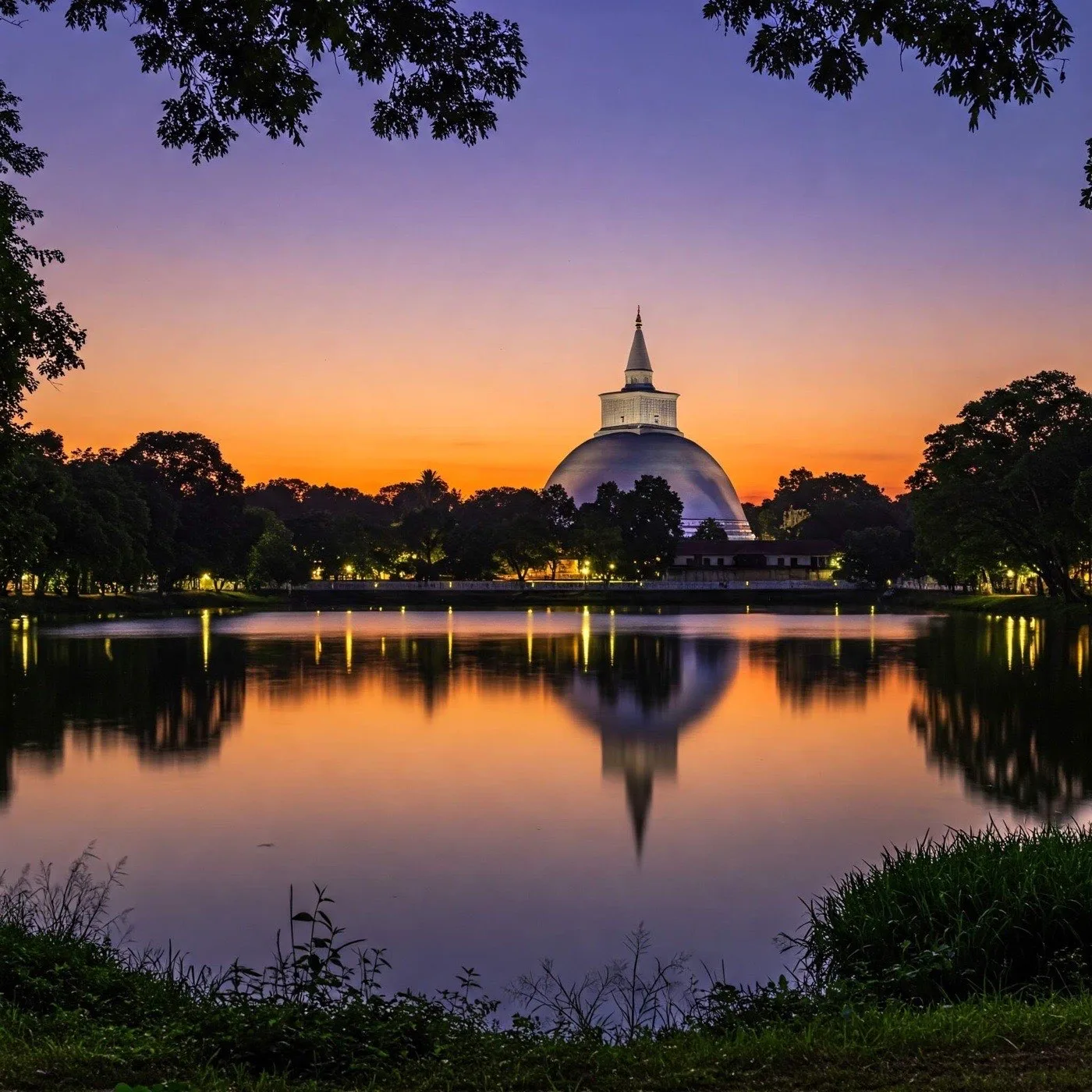
About Anuradhapura
Anuradhapura was Sri Lanka's capital for over 1,300 years, from the 4th century BC to the 10th century AD — one of the longest-lived ancient capitals in the world. At its height, it was one of the most advanced cities in South Asia, with a sophisticated hydraulic civilisation that irrigated vast agricultural plains through an elaborate network of tanks (reservoirs) still functioning today.
The Sacred City — a UNESCO World Heritage Site — is a vast archaeological zone of colossal dagobas (stupas), ruined palaces, bathing pools, and monastic complexes stretching over 40 square kilometres. The Ruwanwelisaya, Jetavanaramaya (once among the world's tallest structures), and Thuparamaya dagobas are among the most impressive Buddhist monuments in Asia.
At the spiritual heart of the city stands the Sri Maha Bodhi — a sacred fig tree grown from a cutting of the tree under which the Buddha attained enlightenment in Bodh Gaya, India. Planted in 288 BC, it is the oldest documented tree in the world and one of Buddhism's most sacred sites, drawing pilgrims from across Asia.
Highlights
- Visit the Sri Maha Bodhi — the world's oldest documented tree (288 BC)
- Stand before the Ruwanwelisaya — a 55m white stupa visible for miles
- Explore the Jetavanaramaya — once the world's third-tallest structure
- Cycle through the ruins of ancient monasteries and royal gardens
- Witness morning pilgrims at the sacred Bodhi tree
- UNESCO World Heritage Site — Sacred City of Anuradhapura
Plan & Book
Hotels & Stays
Search on Booking.com
Tours & Experiences
Browse on GetYourGuide
Bus & Train Tickets
Book on 12Go Asia
Links above are affiliate links. We may earn a small commission at no extra cost to you — it helps keep this site free.
What to See & Do
Sri Maha Bodhi
The world's oldest documented tree — a sacred fig grown in 288 BC from a cutting of the tree under which the Buddha attained enlightenment. Surrounded by a constant stream of pilgrims in white, bearing flowers and oil lamps.
Ruwanwelisaya Dagoba
A magnificent 55m white stupa built by King Dutugemunu in 140 BC — one of the world's largest brick structures. Monks circle it in continuous meditation; the surrounding terrace is alive with offerings.
Jetavanaramaya
Built in the 3rd century AD, this 70m stupa was once the third-tallest structure in the ancient world — taller than the Great Pyramid's first tier. The surrounding monastic complex once housed 3,000 monks.
Isurumuniya Rock Temple
A 3rd-century BC rock temple carved into a granite outcrop above a bathing pond — famous for the 'Isurumuniya Lovers', a masterpiece of Gupta-influenced Sri Lankan sculpture.
Kuttam Pokuna (Twin Ponds)
Two perfectly symmetrical ancient bathing pools, built for monastic use in the 8th century — a stunning example of Anuradhapura-era hydraulic engineering and aesthetic precision.
Mihintale
The sacred mountain 12 km east of Anuradhapura where Buddhism was introduced to Sri Lanka in 247 BC — 1,840 granite steps lead to the summit stupa, with beautiful panoramic views and cave temples en route.
Aukana Buddha Statue
A 12m standing Buddha carved with extraordinary precision in the 5th century AD from a single granite rock — still attached to the rock face at the back, with water draining off the crown as designed 1,500 years ago. One of the finest examples of ancient Sri Lankan sculpture. Located 55 km south-east of Anuradhapura.
Yapahuwa Rock Staircase & Citadel
A majestic carved stone staircase leads up a 90m granite outcrop to a medieval royal citadel — briefly Sri Lanka's capital in the 13th century, housing the Sacred Tooth Relic. The elaborate decorative staircase gateway is considered the finest medieval stone carving in Sri Lanka.
Getting There from Colombo
Several daily trains from Colombo Fort. Second class is comfortable enough for this route.
Intercity express buses available from Colombo Central Bus Stand — fastest public option.
Via A9 north. Easy drive on good road.
The Sacred City is best explored by bicycle — rentals are available near the museum entrance for LKR 300/day.
Best Time to Visit
Avoid the heat of midday — start exploring by 6:30 AM and take a midday break. Poson (June full moon) is the most sacred festival day.
Traveller Tips
- ▸Buy the combined archaeological zone ticket at the entrance — it covers all major sites
- ▸Rent a bicycle — the zone is 40 sq km and walking is impractical in the heat
- ▸White clothing is appropriate near the Bodhi tree — pilgrims appreciate respectful dress
- ▸The Ruwanwelisaya is most atmospheric at dawn when monks in saffron robes circle the stupa
- ▸Anuradhapura is easily combined with Mihintale (12 km east) — where Buddhism arrived in Sri Lanka in 247 BC
- ▸Stay one night if possible — the ruins lit at dusk have a completely different atmosphere
Entry Fee
Combined archaeological zone ticket. Separate minor fees apply for some individual sites.
Sacred City: 6:00 AM – 6:00 PM daily
Ready to Visit Anuradhapura?
We'll build a complete itinerary around your interests, budget, and trip length — from airport arrival to departure.